

Soccer Goal Safety & Anchor Recommendations Guide
Unanchored soccer goals can tip over and cause serious injuries. Proper anchoring is essential to keeping players, coaches, and spectators safe.
This Soccer Goal Safety & Anchor Guide explains the different types of soccer goal anchors and best practices for securing goals safely.
CPSC Soccer Goal Safety Guidelines
Data from the Consumer Product Safety Commission (CPSC) shows that numerous deaths have occurred since 1979 directly as a result of tipped-over soccer goals. In addition, the CPSC estimates that 120 injuries occur per year due to improperly anchored goals.
The CPSC has established specific guidelines for the installation, use, and storage of full-sized, movable soccer goals to prevent future deaths and serious injuries resulting from soccer goal accidents. The CPSC hopes that these guidelines will raise awareness about the dangers of unanchored soccer goals and improper use. A printable PDF of the CPSC Soccer Goal Safety Guidelines can be accessed through this link.
ASTM Soccer Goal Safety Standards
ASTM International has developed the following two safety standards regarding movable soccer goals:
1) ASTM F2950-14 - Standard Safety and Performance Specification for Soccer Goals
- This standard establishes that all soccer goals with a total weight greater than 40 lbs. be required to follow specified anchoring instructions in an effort to reduce injuries and fatalities.
2) ASTM F1938-98 - Standard Guide for Safer Use of Movable Soccer Goals
- The scope of this standard provides guidelines for the proper installation and use of pegs, stakes, and sandbags as soccer goal anchors to prevent deaths and serious injuries resulting from soccer goal tip overs.
Soccer Goal Anchor Types
Soccer goal anchors are categorized into portable below-ground anchors, above-ground weights, and semi-permanent/permanent ground anchoring systems, each designed for specific field surfaces and safety standards. Choosing the correct anchor prevents tip-over accidents and ensures adherence to safety guidelines.
1) Portable Below-Ground Anchors (Natural Grass)
These anchors are ideal for fields where goals need to be moved frequently for training, mowing, or multi-sport field layouts. They penetrate natural turf to hold the base frame down.
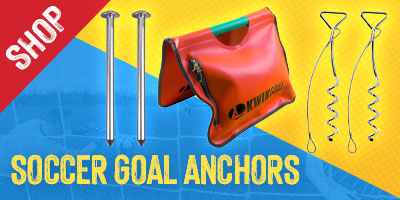
- Auger / Corkscrew Anchors: Spiral-shaped metal stakes that screw deep into the ground. A metal chain or strap connects the top of the screw to the goal's rear base frame.
- J-Hook Staking System: Heavy-duty metal rods shaped like a "J". The hook wraps securely over the goal base tube, and the straight shaft is driven into the turf.
- U-Peg / Staple Anchors: Two-pronged metal stakes shaped like an upside-down "U". They straddle the base frame and are hammered flush with the ground.
- Straight Pegs / Spikes: Long, smooth, or textured metal pins driven through pre-drilled holes in the goal's ground shoes at an angle for optimal leverage.
2) Portable Above-Ground Anchors (Artificial Turf, Hard Courts, & Indoor)
When penetrating the surface is impossible - such as on artificial turf or gym floors - above-ground counterweights must be used.
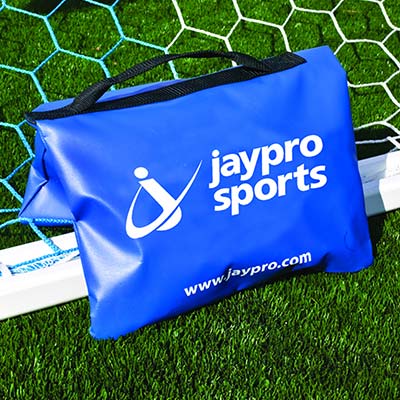
- Saddle Sandbags: Heavy-duty bags designed with a center split or dual pouches that drape directly over the rear ground bar. They must be filled with aggregate sand.
- Steel / Concrete Ballast Weights: Rigid, pre-weighted blocks (often 40 to 60 lbs each) fitted with rubber pads to protect artificial surfaces and steel shackles to chain them to the goal.
3) Semi-Permanent & Permanent Systems (All Surface Types)
These configurations offer maximum safety for dedicated soccer complexes where goals remain stationary for an entire season or indefinitely.
- In-Ground Box Anchors: A heavy-duty steel base is permanently set into an underground concrete footing. A bolt or high-strength tether extends to secure the goal frame. When goals are removed, flush lids cover the boxes safely.
- Ground Sleeves: Perfect for stadium environments, these are subterranean pipe sleeves embedded in concrete. The extended vertical goalposts slide directly down into the sleeves for a completely rigid fit without rear base frames.
Soccer Goal Anchor Bag Recommendations by Model
The following charts outline manufacturer recommendations for the number of goal anchor bags required per soccer goal. Requirements vary by model, size, and design. Always follow the specific guidance provided for your equipment.
Kwik Goal
| Goal Model | Desc. | Wt. | Bag Qty. |
|---|---|---|---|
| Current Models | |||
| 2B9006 | 8' x 24' Pro Premier Competition | 240 lbs. | 6 /goal |
| 2B2001 | 8' x 24' Pro European Match | 240 lbs. | 6 /goal |
| 2B2406SW | 8' x 24' International Portable Match | 240 lbs. | 6 /goal |
| 2B3406 | 8' x 24' Evolution - 4-3/8" Round | 240 lbs. | 6 /goal |
| 2B3806 | 8' x 24' Fusion | 240 lbs. | 6 /goal |
| 2B3906 | 8' x 24' Fusion 120 | 240 lbs. | 6 /goal |
| 2B3916 | 8' x 24' Fusion Pro | 240 lbs. | 6 /goal |
| 2B11 | 8' x 24' Fusion Max | 240 lbs. | 6 /goal |
| 2B3006 | 8' x 24' Deluxe Euro Club | 240 lbs. | 6 /goal |
| 2B5006 | 8' x 24' Academy | 240 lbs. | 6 /goal |
| 2B3805 | 7' x 21' Fusion | 240 lbs. | 6 /goal |
| 2B3005 | 7' x 21' Deluxe Euro Club | 240 lbs. | 6 /goal |
| 2B5005 | 7' x 21' Academy | 240 lbs. | 6 /goal |
| 2B3804 | 6-1/2' x 18-1/2' Fusion | 240 lbs. | 6 /goal |
| 2B3004 | 6-1/2' x 18-1/2' Deluxe Euro Club | 240 lbs. | 6 /goal |
| 2B5004** | 6-1/2' x 18-1/2' Academy | 240 lbs. | 6 /goal |
| 2B3003 | 6-1/2' x 12' Deluxe Euro Club | 120 lbs. | 3 /goal |
| 2B5003** | 6-1/2' x 12' Academy | 120 lbs. | 3 /goal |
| 2B3002** | 4-1/2' x 9' Deluxe Euro Club | 120 lbs. | 3 /goal |
| 2B5002** | 4-1/2' x 9' Academy | 120 lbs. | 3 /goal |
| 2B3001** | 4' x 6' Deluxe Euro Club | 120 lbs. | 3 /goal |
| 2B5001** | 4' x 6' Academy | 120 lbs. | 3 /goal |
| 2B6001** | 3' x 4' Academy Training | 120 lbs. | 3 /goal |
| 2B3000** | 3' x 4' Deluxe Euro Club | 120 lbs. | 3 /goal |
| 2B3024 | 3' x 24' Finishing Goal | 240 lbs. | 6 /goal |
| Discontinued Models | |||
| 2B3306 | 8' x 24' Evolution - 4" x 5" Elliptical | 240 lbs. | 6 /goal |
| 2B3506 | 8' x 24' Evolution - 4" Square | 240 lbs. | 6 /goal |
| 2B3706 | 8' x 24' High School Match Play | 240 lbs. | 6 /goal |
| 2B9004 | 6-1/2' x 18-1/2' Pro Premier Comp. | 240 lbs. | 6 /goal |
Jaypro
| Goal Model | Desc. | Wt. | Bag Qty. |
|---|---|---|---|
| SGP-850 | World Cup | 140 lbs. | 3 /goal |
| SGP-760 | Square | 160 lbs. | 4 /goal |
| SGP-730 | Square | N/A | – |
| SGP-660 | World Fold-Up | N/A | – |
| SGP-600 | Premiere | 140 lbs. | 3 /goal |
| SGP-600AX | Premiere Adjustable | 140 lbs. | 3 /goal |
| SGP-550 | World Class | N/A | – |
| SGP-440 | Round | N/A | – |
| SGP-400 | Round | 160 lbs. | 4 /goal |
| SGP-120 | Square | 170 lbs. | 4 /goal |
| SGP-110 | Round | N/A | – |
| RCG-24S | Club Round | 170 lbs. | 4 /goal |
| CC24S | Club Round | 140 lbs. | 3 /goal |
| RCG-21S | Club Round | 170 lbs. | 4 /goal |
| CC21S | Club Round | 160 lbs. | 4 /goal |
| RCG-18S | Club Round | 240 lbs. | 5 /goal |
| CC18S | Club Round | 240 lbs. | 5 /goal |
| RCG-12S | Club Round | 240 lbs. | 5 /goal |
| CC12S | Club Round | 240 lbs. | 5 /goal |
| RCG-9S | Club Round | 240 lbs. | 5 /goal |
| CC9S | Club Round | 240 lbs. | 5 /goal |
| RCG-6S | Club Round | 240 lbs. | 5 /goal |
| CC6S | Club Round | 240 lbs. | 5 /goal |
- Listed weights apply only when the goal is fully assembled with all included components and installed according to manufacturer instructions.
- Anchors must be placed as close to the rear corners of the goal as possible and evenly distributed between the left and the right sides.
- Listed weights are sufficient for compliance with ASTM F2950 anchored goal testing requirements.
- Goals marked with (**) are exempt from ASTM F2950 testing requirements; listed weights reflect manufacturer recommendations for standard use.
How to Anchor a Soccer Goal
To properly anchor a soccer goal:
- Position the goal on a flat, level surface.
- Install manufacturer-approved anchors or counterweights.
- Secure anchors to the goal frame at designated attachment points.
- Distribute weight evenly, placing anchors near the rear corners.
- Verify all anchors are firmly attached and stable.
- Test the goal by applying a horizontal force to ensure it does not tip or shift.
Proper anchoring is critical to maintaining stability and preventing dangerous tip-overs during use. Always follow manufacturer recommendations and safety standards such as ASTM F2950 when installing and testing anchors.